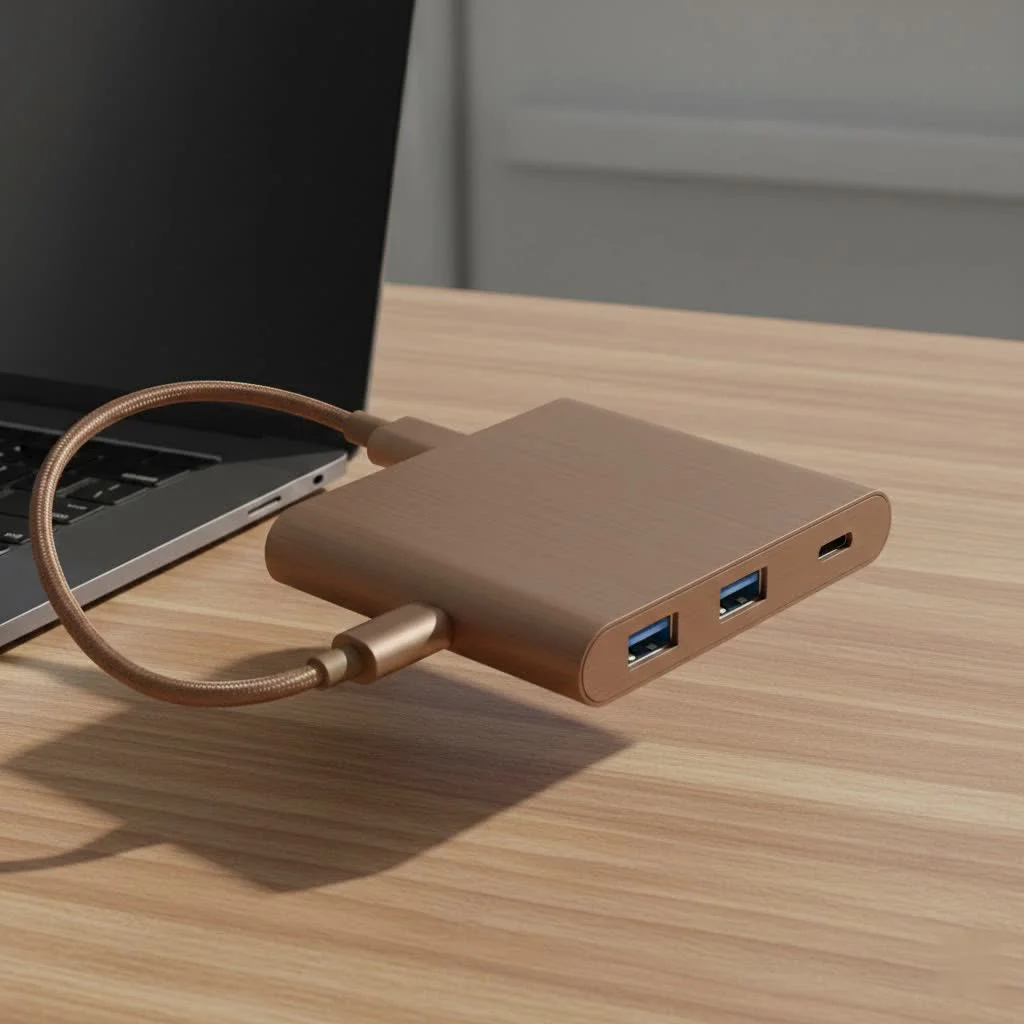
A powered USB hub is an essential accessory that expands a single USB port on your computer into multiple ports while providing a dedicated, stable power source from a wall outlet. This external power supply ensures that high-power peripherals like external hard drives and webcams receive consistent electricity, preventing data transfer errors and enabling simultaneous, full-speed operation for all connected devices.
What Exactly is a Powered USB Hub?
Think of a powered USB hub as a power strip for your USB devices. It’s a compact gadget that plugs into a single USB port on your computer and expands it into multiple ports. The key difference, and its main advantage, lies in its dedicated power source. Unlike unpowered (or “bus-powered”) hubs that draw a limited amount of electricity directly from your computer, a powered USB hub connects to a wall outlet via its own AC adapter. For browse all usb hubs articles on this site.
This external power supply is a major upgrade. It means the hub doesn’t have to share your computer’s limited power resources. Instead, it delivers a consistent and robust stream of electricity to each connected device, ensuring everything runs smoothly without overwhelming your computer.
Why You Absolutely Need a Powered USB Hub
If you connect more than just a keyboard and mouse, the benefits of a powered hub become immediately clear. Relying on an unpowered hub for multiple devices can lead to frustrating issues, like your external hard drive randomly disconnecting or your smartphone charging at a snail’s pace. A powered hub solves these problems and more.
Key Benefits You’ll Notice Immediately:
- Stable Performance for Demanding Devices: High-power peripherals like external hard drives, webcams, printers, and scanners require a stable energy source. A powered USB hub provides the juice they need, preventing data transfer errors and unexpected disconnections.
- Simultaneous, Full-Speed Operation: Because each port gets a dedicated supply of power, you can use all the ports at once without a drop in performance. Run your backup drive, connect your microphone, and charge your phone simultaneously without a hitch.
- Faster and More Reliable Charging: A powered hub can deliver more amperage than a standard computer port, allowing it to charge your devices like smartphones and tablets more efficiently and quickly.
- Protects Your Computer: By offloading the power demand to an external source, a powered hub reduces the strain on your computer’s internal power supply, which can contribute to its longevity.
As our lead hardware analyst at Meeob, David Chen, often says, “Using an unpowered hub for anything more than a mouse and keyboard is like asking a sedan to do a truck’s job. A powered USB hub provides the horsepower your digital life demands, ensuring reliability and performance across all your peripherals.”
How to Choose the Perfect Powered USB Hub for You
With so many options on the market, selecting the right powered USB hub can feel daunting. By focusing on a few key features, you can easily find a hub that perfectly matches your needs.
1. Count Your Ports and Know Your Types
|
Our Picks for the Best USB Hub in 2026
As an Amazon Associate I earn from qualifying purchases.
|
||
| Num | Product | Action |
|---|---|---|
| 1 | Powered USB Hub, Wenter 11-Port USB Splitter Hub (10 Faster Data Transfer Ports+ 1 Smart Charging Port) with Individual LED On/Off Switches, USB Hub 3.0 Powered with Power Adapter for Mac, PC |

|
| 2 | USB C Docking Station with M.2 NVMe SSD Enclosure 10Gbps, 9 in 1 USB-C Hub, Type C SSD Slot with 4K@60Hz HDMI, USB 3.2 Gen2, PD100W, SD/TF Card Reader, Laptop Docking Station for Dell/HP/Lenovo/Mac |
|
| 3 | P9R PRO USB C Hub Ethernet, 10 in 1 USB Docking Station 10Gbps with 4K@60Hz HDMI, USB C and 2 USB A 3.2, LAN, 2 USB A 2.0, PD 100W, SD/TF Ports, USB to Ethernet Adapter for PC, iPhone 16/15, Mac |
|
| 4 | Powered USB Hub 10Gbps, intpw 9-Port USB 3.2 Hub, USB C Hub with USB A/USB C 3.2, 4 USB 3.0, 2 PD 45W Charging Ports, 65W Power Adapter and 3.3FT Cable, Aluminum USB Hub for Laptop, iPhone 17/16/15,PC |
|
| 5 | Anker Laptop Docking Station Dual Monitor, 8-in-1 USB C Hub, 4K Dual Monitor with 2 HDMI, 1 Gbps Ethernet Hub, 85W Power Delivery, SD Card Reader for MacBook Pro, XPS and More (Charger not Included) |
|
| 6 | 13 in 1 USB C Docking Station - Dual Monitor, Triple Display, 8 USB C/A Ports, Ethernet, Audio - LIONWEI USB C Hub for MacBook,Dell,HP,Lenovo,Surface |
|
| 7 | 3-in-1 USB C Splitter, 3 in 1 Type-C Charging Data Cable Data Transmission Decive Charging Adapter Power Charger Equipment for ome Office Use, Fast & Efficient |
|
| 8 | UGREEN USB 3.0 Hub, 4 Ports USB A Splitter Ultra-Slim USB Expander for Mouse, Keyboard, Flash Drive, U Disk, Printer Compatible with Laptop, Desktop PC, Xbox, PS5, and More |
|
| 9 | Anker USB Hub 4 Ports with 5Gbps Data Transfer, Multiple USB 3.0 Hub, USB Splitter for Laptop, Extender for A Port Laptop, PC, Desktop and More [Charging Not Supported](0.7 ft USB-A) |
|
| 10 | USB Hub 3.0, 7-Port USB Hub Splitter with Individual On/Off Switches and Lights, 3.2ft/1m Long Cable Compatible with MacBook, Laptop, Surface Pro, PS4, PC, Flash Drive, Mobile HDD |
|
First, consider how many devices you need to connect. It’s wise to choose a hub with more ports than you currently need to future-proof your setup. Pay attention to the type of ports as well:
- USB-A: The traditional, rectangular port. Still the most common type and essential for most keyboards, mice, and flash drives.
- USB-C: The newer, oval-shaped, reversible port. It offers faster data transfer speeds and higher power delivery. Many modern hubs offer a mix of both USB-A and USB-C.
2. Check the Data Transfer Speed
Not all USB ports are created equal. The speed determines how quickly data moves between your device and computer.
- USB 2.0: An older standard with speeds up to 480 Mbps. Suitable for basic peripherals like keyboards and mice.
- USB 3.0 (or USB 3.1 Gen 1 / USB 3.2 Gen 1): Offers much faster speeds of up to 5 Gbps. This is the ideal choice for external hard drives, SSDs, and flash drives.
- USB 3.1 Gen 2 (or USB 3.2 Gen 2): Provides speeds up to 10 Gbps, perfect for high-performance devices like external SSDs used for video editing.
3. Don’t Overlook the Power Output
The total power output, measured in amperes (A) or watts (W), determines how effectively the hub can power and charge multiple devices at once. Look for hubs that clearly state their power capacity. A good powered hub should provide at least 2A (10W) of total output, with higher-end models offering significantly more. Some advanced USB-C hubs even support Power Delivery (PD), which can be powerful enough to charge a laptop.
4. Build Quality and Design
A well-built hub will last longer. Aluminum casings are generally more durable and better at dissipating heat than plastic ones. Also, consider the hub’s design. Do you need a compact hub for travel, or a larger one that can sit neatly on your desk? Cable length is another practical consideration—ensure the hub’s cable is long enough to reach from your computer to your desired workspace location.
Frequently Asked Questions
What is the main difference between a powered and an unpowered USB hub?A powered USB hub has its own external power adapter that plugs into a wall outlet, providing consistent power to each port. An unpowered (bus-powered) hub draws all its power directly from the computer it’s connected to, which is often insufficient for multiple or high-drain devices.
Can a powered USB hub damage my devices?No, a quality powered USB hub from a reputable brand will not damage your devices. USB devices are designed to draw only the amount of power they need. The hub simply makes adequate power available; it doesn’t force it into your devices.
How many devices can I connect to a powered hub?You can connect as many devices as there are ports. The external power supply ensures that even if you use every single port, each device will receive a stable connection and sufficient power to operate correctly.
Do I need to install any software or drivers?Generally, no. Powered USB hubs are “plug-and-play,” meaning they work automatically as soon as you connect them to your computer and plug them into the wall. Your operating system will recognize the hub and the connected devices without any extra steps.
The Final Verdict
In an increasingly connected digital world, running out of USB ports is more than a minor inconvenience—it’s a roadblock to productivity. A powered USB hub is a simple, affordable, and highly effective solution. It not only expands your connectivity options but also provides the stable, robust power that modern peripherals demand. By choosing the right hub, you can create a more organized, efficient, and reliable workspace, ensuring all your devices perform at their best, all the time.
How to Choose the Perfect Powered USB Hub
Selecting the right powered USB hub involves considering port types, data transfer speeds, power output, and build quality to match your specific connectivity needs.
Determine the number of devices you need to connect and consider future expansion. Identify whether you need traditional USB-A ports, newer USB-C ports, or a mix of both for your peripherals.
Evaluate the required data transfer speeds for your devices. USB 3.0 (5 Gbps) is ideal for external hard drives, while USB 3.1 Gen 2 (10 Gbps) is better for high-performance SSDs and video editing.
Look for a hub that clearly states its power capacity, measured in amperes (A) or watts (W). A good powered hub should offer at least 2A (10W) of total output to effectively power and charge multiple devices.
Opt for durable materials like aluminum for better heat dissipation and longevity. Decide if you need a compact hub for travel or a larger desktop model, and ensure the cable length is suitable for your workspace.
Get our weekly buyer guide
Practical specs, not advice. Unsubscribe anytime.
I bought one of these to help with my multiple devices, and it does the job for the most part. It’s nice to have extra ports for my printer and a USB stick. However, I noticed that when I connect my high-power gaming headset, it sometimes struggles a bit, even with the external power supply. It’s not a deal-breaker, but something to be aware of if you have very power-hungry devices.
I finally got a powered USB hub after struggling with my external hard drive constantly disconnecting. The dedicated power source from the wall outlet makes such a difference! Now I can run my hard drive, webcam, and charge my phone all at once without any issues. It’s exactly what I needed to keep everything running smoothly.
This hub is a game-changer for my home office setup. I love that it expands a single USB port into several, which is perfect since my laptop only has two. I’m able to connect my keyboard, mouse, and a couple of other peripherals without any lag. My only minor complaint is that the power cord is a bit short, so I had to rearrange my desk a little.
I was always running out of USB ports on my desktop, and unpowered hubs just weren’t cutting it for my external SSD. This powered hub is fantastic! Everything gets consistent electricity, and I haven’t had any data transfer errors since I started using it. It’s like a power strip for my USB devices, just as described, and it works perfectly.