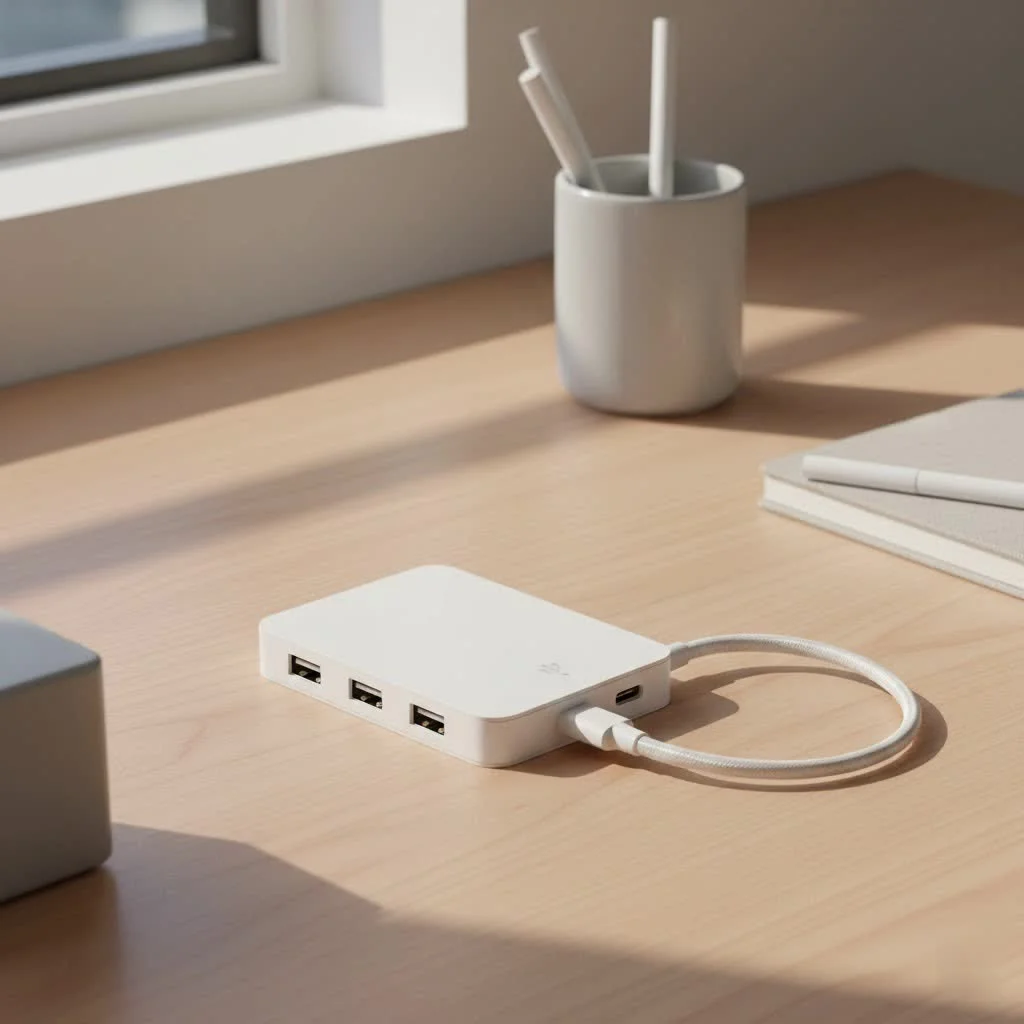
A MacBook USB hub is an essential accessory that expands a single USB-C port on your MacBook into multiple connections, allowing you to connect various devices like external monitors, USB-A peripherals, and SD cards. This guide from Meeob, drawing on over a decade of experience with connectivity solutions, will help you select the ideal hub to match your workflow and maximize your MacBook’s utility.
Why Do You Even Need a MacBook USB Hub?
Apple’s shift to the versatile USB-C port in pursuit of thinner, lighter laptops means that traditional devices using USB-A, HDMI, and other connectors require an adapter. A MacBook USB hub acts as a bridge, transforming one USB-C port into a variety of useful connections. This allows you to:
- Connect to an external 4K monitor or TV via HDMI.
- Transfer photos from your camera’s SD card.
- Plug in a reliable wired Ethernet connection for faster internet.
- Use your favorite USB-A keyboard, mouse, and external hard drives.
- Charge your MacBook and all connected devices simultaneously.
Without a hub, you would need to purchase and carry multiple individual adapters, which is both expensive and inconvenient for daily use.
The Key Features to Look For in a MacBook USB Hub
Understanding the technical specifications of a USB hub can be complex. Here’s a breakdown of the most important features to consider for an informed decision.
Port Selection: What Connections Do You Need?
The most crucial factor is the selection of ports. Avoid paying for ports you will never use by considering your daily workflow.
- USB-A (3.0/3.1): Essential for connecting legacy devices such as mice, keyboards, flash drives, and external hard drives. Look for hubs with at least two of these ports.
- HDMI: A must-have for connecting to external monitors, TVs, or projectors. Verify if it supports 4K resolution and at what refresh rate (30Hz is common, but 60Hz provides a smoother experience).
- SD/microSD Card Readers: If you are a photographer, videographer, or drone pilot, this feature is non-negotiable. It eliminates the need for a separate card reader.
- Ethernet Port: For users requiring a stable, high-speed internet connection for gaming, streaming, or large file transfers, a hub with a Gigabit Ethernet port is highly beneficial.
- USB-C Power Delivery (PD): This is a critical feature that allows you to charge your MacBook through the hub. You connect your MacBook’s charger to the hub, which then passes power to your laptop while simultaneously operating all other connected devices.
- Audio Jack (3.5mm): While many MacBooks still include an audio jack, some models do not. If you rely on wired headphones, this port can be a valuable addition.
Power Delivery (PD): The Secret to a One-Cable Setup
|
Our Picks for the Best USB Hub in 2026
As an Amazon Associate I earn from qualifying purchases.
|
||
| Num | Product | Action |
|---|---|---|
| 1 | UGREEN USB 3.0 Hub, 4 Ports USB A Splitter Ultra-Slim USB Expander for Mouse, Keyboard, Flash Drive, U Disk, Printer Compatible with Laptop, Desktop PC, Xbox, PS5, and More |

|
| 2 | P9R PRO USB C Hub Ethernet, 10 in 1 USB Docking Station 10Gbps with 4K@60Hz HDMI, USB C and 2 USB A 3.2, LAN, 2 USB A 2.0, PD 100W, SD/TF Ports, USB to Ethernet Adapter for PC, iPhone 16/15, Mac |
|
| 3 | USB C Docking Station with M.2 NVMe SSD Enclosure 10Gbps, 9 in 1 USB-C Hub, Type C SSD Slot with 4K@60Hz HDMI, USB 3.2 Gen2, PD100W, SD/TF Card Reader, Laptop Docking Station for Dell/HP/Lenovo/Mac |
|
| 4 | Anker Laptop Docking Station Dual Monitor, 8-in-1 USB C Hub, 4K Dual Monitor with 2 HDMI, 1 Gbps Ethernet Hub, 85W Power Delivery, SD Card Reader for MacBook Pro, XPS and More (Charger not Included) |
|
| 5 | USB Hub 3.0, 7-Port USB Hub Splitter with Individual On/Off Switches and Lights, 3.2ft/1m Long Cable Compatible with MacBook, Laptop, Surface Pro, PS4, PC, Flash Drive, Mobile HDD |
|
| 6 | Anker USB Hub 4 Ports with 5Gbps Data Transfer, Multiple USB 3.0 Hub, USB Splitter for Laptop, Extender for A Port Laptop, PC, Desktop and More [Charging Not Supported](0.7 ft USB-A) |
|
| 7 | Powered USB Hub 10Gbps, intpw 9-Port USB 3.2 Hub, USB C Hub with USB A/USB C 3.2, 4 USB 3.0, 2 PD 45W Charging Ports, 65W Power Adapter and 3.3FT Cable, Aluminum USB Hub for Laptop, iPhone 17/16/15,PC |
|
| 8 | 13 in 1 USB C Docking Station - Dual Monitor, Triple Display, 8 USB C/A Ports, Ethernet, Audio - LIONWEI USB C Hub for MacBook,Dell,HP,Lenovo,Surface |
|
| 9 | Powered USB Hub, Wenter 11-Port USB Splitter Hub (10 Faster Data Transfer Ports+ 1 Smart Charging Port) with Individual LED On/Off Switches, USB Hub 3.0 Powered with Power Adapter for Mac, PC |
|
| 10 | 3-in-1 USB C Splitter, 3 in 1 Type-C Charging Data Cable Data Transmission Decive Charging Adapter Power Charger Equipment for ome Office Use, Fast & Efficient |
|
Power Delivery is a transformative feature. Without it, one of your MacBook’s valuable USB-C ports would be occupied solely for charging, and another for the hub. With PD, you can achieve a streamlined, one-cable setup.
Consider the wattage carefully. Your MacBook charger might be 67W or 96W, but the hub itself consumes 5-15W to operate. Therefore, if a hub is rated for 100W PD passthrough, it will typically deliver 85-95W to your MacBook. For most MacBook Air or Pro users, a hub offering at least 60W of power delivery is recommended.
Data Transfer Speeds: Don’t Get Stuck in the Slow Lane
USB ports vary in speed. You will encounter terms like USB 3.0, 3.1, and 3.2. Here is a simple explanation:
- USB 3.0 (also called USB 3.2 Gen 1): Provides speeds up to 5Gbps. This is sufficient for most everyday peripherals like mice, keyboards, and webcams.
- USB 3.1 (also called USB 3.2 Gen 2): Increases the speed to 10Gbps. This is ideal for rapidly transferring large files from external SSDs.
For the majority of users, 5Gbps is adequately fast. However, if your work involves large video files or frequent backups to high-speed external drives, opt for a hub that supports 10Gbps speeds.
Thunderbolt vs. USB-C: What’s the Difference?
This is a common source of confusion. All Thunderbolt ports (3, 4, and 5) utilize the USB-C connector shape but offer significantly greater power and bandwidth.
- USB-C Hub: A standard hub that provides a variety of ports and is compatible with any USB-C equipped device. It meets the needs of most users and is more affordable.
- Thunderbolt Dock: A high-performance device that leverages the full bandwidth of a Thunderbolt port (40Gbps). It can support multiple high-resolution displays (e.g., dual 4K at 60Hz), daisy-chaining of other Thunderbolt devices, and faster data transfer. Thunderbolt docks are also considerably more expensive.
As hardware analyst David Chen from Tech-Clarity Insights notes, “For 90% of MacBook users, a high-quality USB-C hub provides the perfect balance of functionality and cost. A Thunderbolt dock is a professional tool for power users who need to drive multiple 4K displays or work with massive video files.”
For most individuals, a reliable MacBook USB hub using the USB-C standard is the appropriate choice.
How to Choose the Right MacBook USB Hub for You
To simplify the selection process, let’s consider a few common user types and their specific requirements.
For the Student or Everyday User:
You primarily use your MacBook for browsing, writing documents, and streaming media. You occasionally need to connect a flash drive or an external display for presentations.
- Your Ideal Hub: A compact, portable hub featuring 2-3 USB-A ports, an HDMI port, and an SD card reader is perfect. Power Delivery is a significant advantage for convenience.
For the Remote Worker or Hybrid Professional:
Your MacBook serves as your primary office device. You have a dedicated desk setup with an external monitor, a full-size keyboard and mouse, and frequently participate in video calls where a stable internet connection is crucial.
- Your Ideal Hub: Look for a model with 4K@60Hz HDMI support, a Gigabit Ethernet port, multiple USB-A ports for all your peripherals, and at least 85W of Power Delivery to keep your MacBook Pro charged under heavy load.
For the Creative Professional (Photographer/Videographer):
You are constantly offloading large files from cameras and editing on the go. Speed and efficiency are your top priorities.
- Your Ideal Hub: Prioritize a hub with fast SD and microSD card readers (UHS-II if possible) and USB-A ports offering 10Gbps data speeds for connecting fast external SSDs. Multiple display outputs and robust Power Delivery are also essential.
Frequently Asked Questions (FAQ)
Will a cheap USB hub damage my MacBook?
A poorly made, uncertified USB hub can potentially cause issues, ranging from unstable connections to, in rare instances, electrical damage. It is always best to invest in a hub from a reputable brand that includes over-current and short-circuit protection to safeguard your device.
Do MacBook USB hubs overheat?
It is normal for a hub to become warm during use, especially when utilizing Power Delivery and multiple ports simultaneously. This warmth is due to power conversion and data management. However, it should not become dangerously hot to the touch. Reputable brands design their hubs with aluminum casings to effectively dissipate heat.
Can I use any USB-C hub with my MacBook?
For the most part, yes, any USB-C hub can be used with your MacBook, as the USB-C standard is designed for universality. However, for specific features like particular display refresh rates (e.g., 4K@60Hz) or full Thunderbolt speeds, both your MacBook and the hub must support those capabilities.
What is the real difference between a USB hub and a dock?
A USB hub is typically smaller, bus-powered (drawing power from the laptop), and more portable. A dock is a larger, stationary unit that almost always has its own dedicated power adapter. Docks generally offer more ports, higher power output, and advanced features like the ability to drive multiple external monitors, making them a more permanent desktop solution.
Conclusion: The Right Hub Unlocks Your MacBook’s Potential
A MacBook is a powerful tool, but its full potential is only unlocked when you can easily connect it to the world around you. Choosing the right MacBook USB hub is a small investment that pays huge dividends in convenience, productivity, and flexibility.
By evaluating your personal needs—the ports you use daily, your power requirements, and your workflow—you can confidently select a hub that transforms your single USB-C port into a versatile command center. Forget the dongle life and embrace the simplicity of a single, powerful accessory that bridges the gap between your MacBook and all your favorite devices.
Frequently Asked Questions
Will a cheap USB hub damage my MacBook?
A poorly made, uncertified USB hub can potentially cause issues, from unstable connections to, in rare cases, electrical damage. It is always best to invest in a hub from a reputable brand that includes over-current and short-circuit protection to safeguard your device.
Do MacBook USB hubs overheat?
It is normal for a hub to become warm during use, especially when utilizing Power Delivery and multiple ports simultaneously. This warmth is due to power conversion and data management. However, it should not become dangerously hot to the touch. Reputable brands design their hubs with aluminum casings to effectively dissipate heat.
Can I use any USB-C hub with my MacBook?
For the most part, yes, any USB-C hub can be used with your MacBook, as the USB-C standard is designed for universality. However, for specific features like particular display refresh rates (e.g., 4K@60Hz) or full Thunderbolt speeds, both your MacBook and the hub must support those capabilities.
What is the real difference between a USB hub and a dock?
A USB hub is typically smaller, bus-powered (drawing power from the laptop), and more portable. A dock is a larger, stationary unit that almost always has its own dedicated power adapter. Docks generally offer more ports, higher power output, and advanced features like the ability to drive multiple external monitors, making them a more permanent desktop solution.
What power delivery wattage is recommended for a MacBook hub?
For most MacBook Air or Pro users, a hub offering at least 60W of power delivery is recommended. While your MacBook charger might be 67W or 96W, the hub itself consumes 5-15W to operate, meaning a 100W PD passthrough hub typically delivers 85-95W to your laptop.
Get our weekly buyer guide
Practical specs, not advice. Unsubscribe anytime.
I was hoping this would be the perfect solution for my MacBook Air, especially for the wired Ethernet connection. While the Ethernet works fine, I’ve noticed some occasional lag when I have both an external monitor and a couple of USB-A devices connected simultaneously. It’s not a dealbreaker, but it’s a bit annoying when I’m trying to multitask. Maybe I just need a more powerful hub.
Finally, a hub that actually delivers! I needed something reliable for my MacBook Pro to handle multiple peripherals, including a fast internet connection. The stable wired Ethernet connection is fantastic for my online gaming and video calls. It’s great to have all these options from a single USB-C port, really cleans up my desk.
This hub is pretty solid for the price. I mainly got it to transfer photos from my camera’s SD card and it works perfectly for that. I also appreciate having the extra USB-A ports for my mouse and a flash drive. My only minor complaint is that it gets a little warm when I have a lot of things plugged in, but it hasn’t affected performance.
I’ve been struggling with connecting my older USB-A devices to my new MacBook Pro, and this hub has been a lifesaver. I can finally use my external hard drive and keyboard without needing a bunch of separate dongles. The ability to connect to an external 4K monitor via HDMI is also a huge plus for my home office setup. It’s super compact and feels really well-made.